Still(ish) Life
& my love for fruit poems

One of my first poem-loves was Seamus Heaney’s “Blackberry-Picking.” I was enamored by the image of ripened fruit, and how well he painted it: “you ate that first one and its flesh was sweet/ like thickened wine: summer’s blood was in it.” Or later in the poem, the disillusionment of nature’s decay: “a rat-grey fungus, glutting on our cache.” You can read the whole thing here.
When I read the poem, I could nearly taste the fruit, feel it dribble down my chin, watch my hands turn dark with the stain of it. In the second stanza, I felt the visceral disappointment of the lost berries. Heaney had conjured up the image so well, it was like staring at a painting.
My grandparents bought a painting once that they hung over the piano. The first time they showed it to us, it was clear to me why they’d liked it. It was a still life. A simple bowl of fruit with droplets of water glistening on them, as if they’d just been rinsed. My grandparents pointed out the water droplets, amazed that the painting had captured them so perfectly. You’d almost think someone had splashed the canvas itself.

Poetry is a little like that still life. At least, some of my favorite poems are. A moment distilled, as vivid in the reader’s mind as a painting in a museum. A still(ish) life. Because poetry has the ability to move. To exhale. Heaney’s poem moves from the abundance of summer harvest to its solemn farewell so quickly, and leaves the reader breathless. And pining for a ripe blackberry.
Of course, a still life isn’t complete without fruit. Ripe red berries near bursting, an apple split to its core. More poetry needs the tantalizing touch of citrus, or the temptation of grapes hanging on a vine. So much can be done with fruit. So much delightful vocabulary! Pith, flesh, core, juice, skin, seeds! And the sense of taste and smell they can give truly have the ability to ground your reader in your work, with a near universal experience. The image is made real when the other senses are present. Like a still life, the poem can captivate an audience with what it lays out on the table.
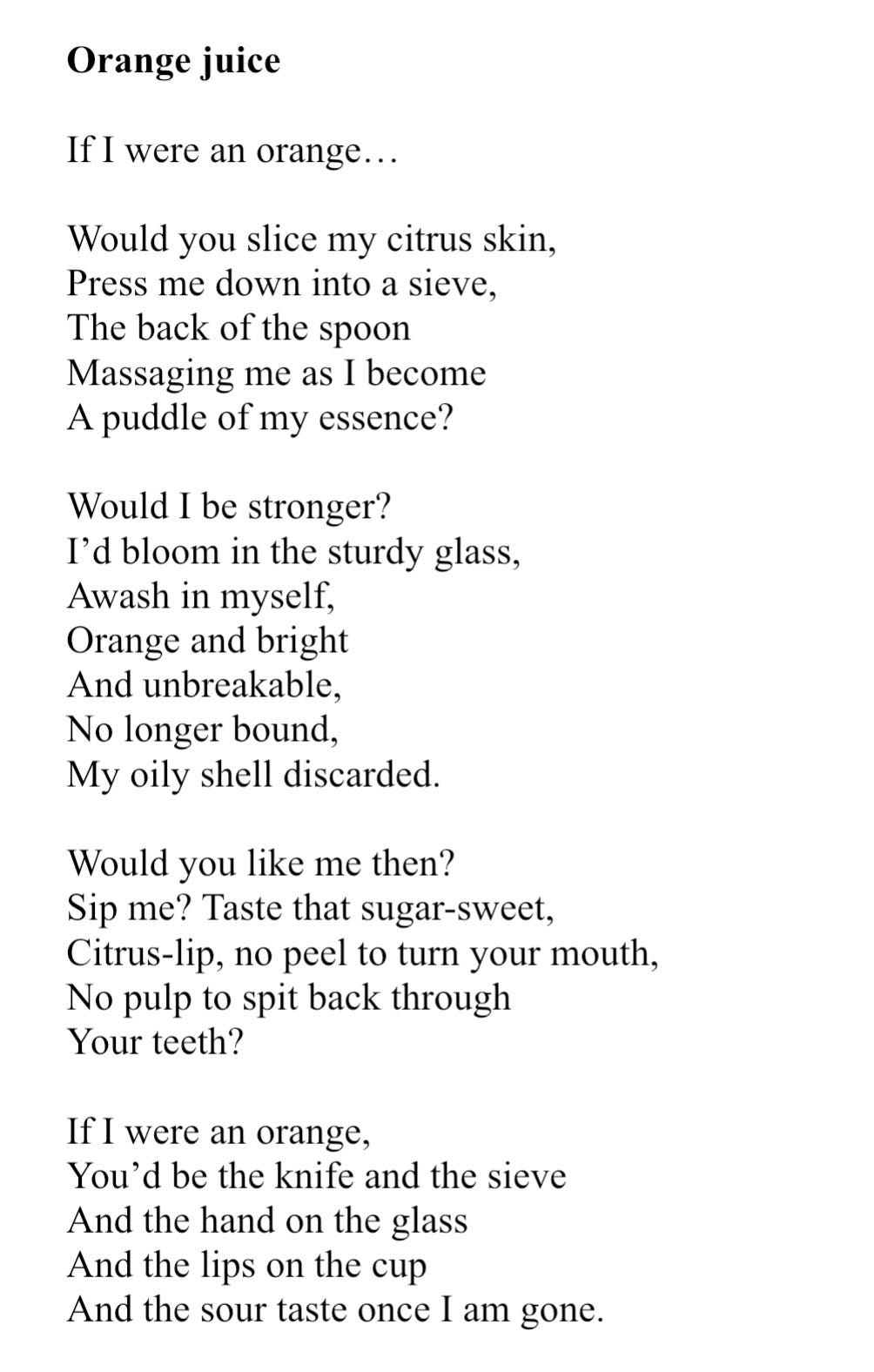
I think writing poetry with the still life in mind is a great exercise. Fruit poems are some of my favorites. So in the interest of adding more fruit-flavored poetry to the world, here is a poem I wrote after eating a delightful orange: